Showing posts with label Historic Homes. Show all posts

Monday, June 2, 2014

Vaile Mansion Stands Proudly As A Kansas City Architectural Gem

If you like old homes and Kansas City history, then Vaile Mansion in Independence, MO is the place to go.

Even better, this Saturday will be the Vaile Strawberry Festival, an annual event held on the mansion grounds, which includes lots of strawberry treats and approximately 100 antique vendors/craft booths set up on the expansive lawn.

I can't stress enough that, if you do visit Vaile Mansion, be sure you take the guided tour of the mansion's interior.  It is like taking an instant and intimate step back into Kansas City's turbulent and affluent history.  

Built in 1881 in the Second Empire Style by Harvey Vaile, the landmark is a 31-room, beautifully restored home with a rich history.  It was home to Vaile's wife, Sophia, until her death in the mansion in 1883 and Mr. Vaile until his death in the home in 1894.  


Vaile Mansion was designed by Kansas City architect Asa Cross with nine marble fireplaces and  a beautiful wood/glass entryway into the home.  


Step through the tiled entryway into the 40-foot long grand hall, and you realize you have entered a different era. 


The tour begins with the drawing room (gentlemen's parlor).  This opulent space contains 14-foot ceilings, 11-foot windows, and is repainted in its original green color.  

Mr. Vaile was an abolitionist, teacher, lawyer, cattle rancher, major player in establishing the Republican party in Kansas City and an entrepreneur who established the Star Mail Routes, which ran mail and other freight between here and Santa Fe, NM.  With such a varied background, imagine the conversations that might have taken place in this room.   


From the drawing room, the house flows into the music room, which contains one of the mansion's original crystal chandeliers, an 1871 Lindeman Grand piano and a working Regina music box.  


The music room was probably one of the busiest rooms in the Vaile household and is adorned with a Vermont marble fireplace.


From there, the music room leads into the dining room, which has an outdoor-themed mural on the ceiling depicting amenities once on the grounds of the estate - including a pond, boathouse and greenhouse.


The table is made from what was once a square grand piano.


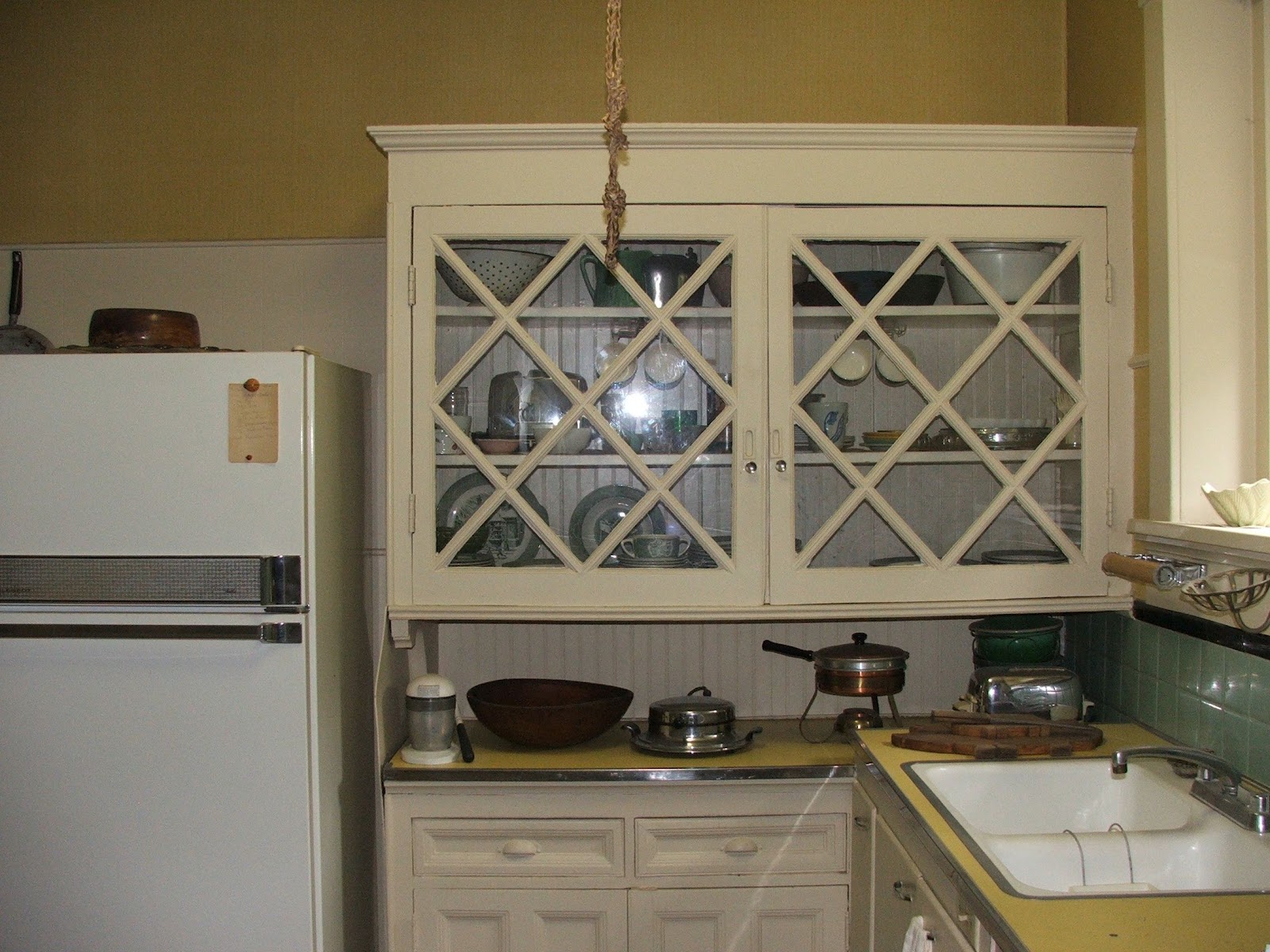
Past the dining room is the serving/warming kitchen (the cooking kitchen was in the basement along with some of the servants' quarters and laundry facilities) and the butler's pantry.


The kitchen contains an antique Acorn stove and a German icebox. The butler's pantry has lots of storage room for dishes, silverware and utensils.


To the southwest of the kitchen is the water tower room.  When Vaile Mansion was built, one of its many innovative features was a self-sustaining water supply.  The house had a 6,000 gallon water tower which allowed water to flow to the upper floors.  

Today the mansion is connected to city water and the tank has been removed.  The room is now set up as a breakfast/eating area.


Also on the first floor of the mansion is the informal parlor, which is where the Vailes would have spent their time when they weren't entertaining guests.


The informal parlor has original pocket doors that separate it from the ladies parlor and a red decorative theme.  It is the smallest parlor in the home and also boasts one of the home's original chandeliers.


The formal parlor is the last room open to the public on the first floor.  It has the most expensive mantle in the home, made from Italian marble. 


This is where Mrs. Vaile would have formally entertained ladies who came to the mansion.


Ascending to the second floor, you can see the original skylight in the roof, which lets in lots of natural light.  


The floors on the second story are original to the home, and this level contains a large hallway, a gift shop, two bathrooms, the master bedroom, guest bedrooms, the library and the nature's bower.


The bathrooms were built to have running hot and cold water, flushing toilets, and copper bathtubs, which was quite an extravagance at the time.


The guest bedrooms have a separate bathroom from the main bedroom.  


All the rooms feel cozy and spacious at the same time.


The main bedroom was the location of a scandalous ceiling mural - a mural of a woman who is nude from the waist up.  


Today the woman has a transparent piece of material shrouding her upper body.  It is a common tale that this controversial art kept Mrs. Vaile from being accepted by the "proper" ladies of society and that the woman in the painting is actually her.


The nature's bower (Mr. Vaile's smoking room) is quite an interesting room.  To make it seem as close to nature as possible, Mr. Vaile had dark green carpeting on the floor, and the ceiling is a dark blue with stars like the night sky.


The knotholes and imperfections in the variety of woodwork used in the nature's bower also makes it appear to be full of human and animal faces, and " J.H. Kay October 12, 1881" is mysteriously inscribed above the door.  


The library is where Mr. Vaile often worked when he was home.  


Here, visitors can read Mr. Vaile's obituary, see a desk which belonged to the home's architect, browse photos of the mansion's restoration, and view a beautiful donated mobile desk on wheels.   


The third floor of the mansion is not open to the public tour.  The original plans called for a billiard room and a ball room on this level, but it was never completed.  The basement of the home is also not open to the public.


Behind the mansion is the only standing outbuilding left on the once expansive property - the carriage house.  Today it is a private residence and not part of the mansion grounds.


After The Vailes passed, the mansion was used for a variety of functions including a women's college, an inn, a private asylum and for many years, a nursing home. 

In the early 1980s, the home was turned over to the Vaile Victorian Society who tirelessly renovated and restored the home and decorated it with vintage furnishings.   

Today, Vaile Mansion is on the National Register of Historic Places and is an Independence Historic Landmark.  

If you would like to see Vaile Mansion for yourself, it is located at 1500 N. Liberty in Independence and is open from April through October and again through the holiday season when it is decorated for a beautiful Victorian Christmas.  

April 1st - End of Oct
Mon-Sat 10 AM - 4 PM
Sun 1 PM - 4 PM

Closed for Decorating Nov 1-25.

Holiday Hours:  Nov 25 - Dec 30
Closed Dec 23-25
Mon - Sat 10 AM - 4 PM
Sun 1 - 4 PM

Admission $6.00
Children/Students $3.00
Seniors/Groups $5.00


If you plan on attending the Strawberry Festival on June 7th, the hours are 9 AM - 4 PM.  

Entrance to the grounds, which at one time included fountains, a 48,000-gallon wine cellar and arbors, is free.  

There will still be a fee for guided mansion tours (which take less than an hour.) 

Call (816) 833-1646 for more information about festival activities or (816) 325-7430 for more information about the mansion.

Sunday, September 23, 2012

The Toy and Miniature Museum of Kansas City Is A World-Class Museum With A Home Town Feel

-->
The Toy and Miniature Museum of Kansas City
Not many things take me by surprise, but my recent visit to The Toy and Miniature Museum of Kansas City did just that.

When I decided to check out the museum, I pictured myself entering a small building filled with a boring collection of old, dusty toys and a few miniatures for viewing. 

I could not have been more wrong.  This facility is a world-class museum filled with more fascinating items than I could ever begin to describe.

First of all, the massive collection of priceless toys and miniatures is housed in the gorgeous 38-room Tureman Mansion, which was designed by architect John McKechnie and completed in 1911 for prominent Kansas City physician Dr. Herbert Tureman and his family.

Entering the Toy and Miniature Museum
The home sits majestically back from the street atop a hill on the western edge of the University of Missouri – Kansas City (UMKC) campus and has its own interesting history.

Nell Donnelly, wealthy owner of the Donnelly Garment Factory, and her husband were leasing the mansion in 1931 after Dr. Tureman passed away. 

On December 16 of that year, Donnelly and her chauffeur, George Blair, were kidnapped at gunpoint from the driveway of the home and held for ransom in Bonner Springs.  To everyone’s relief, both were rescued two days later with the help of James A. Reed, a local politician and attorney, and John Lazia, a Kansas City mob boss.

In 1966, UMKC became the owner of the Tureman Mansion when Marie Tureman passed away and left the home to the university. 

A View of Tureman Mansion From The Street
The Toy and Miniature Museum moved into the building in 1982 and has since expanded twice to its current size of 33,000 square feet.

The museum was created by Mary Harris Francis and Barbara Marshall.  Both women were avid collectors, but Francis liked collecting antique dollhouses while Marshall enjoyed miniatures. 

Eventually, their individual collections grew so large that they were urged to open a museum.  In 1979, they formed a not-for-profit foundation and the Toy and Miniature Museum of Kansas City was born.

Francis and Marshall also had assistance from Jerry Smith, who was a Kansas City Buick dealer before his retirement, and a passionate toy collector himself.  Many of his priceless toys and commercial pieces are also displayed within the museum’s walls.

When you enter the building, you are greeted by a docent.  This is nice because you get an idea of what you will be seeing and learn details about some of the museum’s oldest, most interesting, and most unusual pieces.

The toy collection, which spans the first and second floors of the mansion, includes one-of-a-kind antique dollhouses, mechanical toys, teddy bears, board games, child-sized kitchen and home appliances, furniture, foreign toys, specialized collections and much more.

The largest dollhouse in the museum, known as the Coleman House, stands nine feet tall and seven feet wide.  It originally belonged to the prominent Coleman family from Lebanon, Pennsylvania and appears to have had gas lighting and running water at one time. 

Georgiana is the oldest doll in the museum and dates back to the 1750s.  She is made of wood, has glass eyes, and even sports a wig made from human hair. 

As you walk from gallery to gallery, you slowly realize how many items are actually in the museum’s inventory.  There are collections of cars, trains, planes, circus toys and patriotic items, which include George and Martha Washington dolls along with a number of Uncle Sam collectibles. 

There is a room devoted to numerous Noah’s Arks with animals, a collection of toy soldiers, cowboys and Indians, jungle animals, tea sets, fire memorabilia, paper dolls, banks, churches – including a lovely wood church made by a German cabinet maker, a large grouping of Star Wars dolls and figures, which was the most successful movie-related toy line ever, and the list goes on.

Additionally, the museum houses one of the largest marble collections in the world.  An entire space is devoted to marble art, marble games, marble jewelry, marble contraptions, and drawers full of marbles of all sizes and designs for visitors to examine.

And if you are a Barbie fan, the museum has a special Barbie exhibit running through 2012.  In this gallery, you are able to view the very first Barbie and everything else Barbie you can imagine, including a Barbie dictionary, records, jewelry, purses, puzzles, and even Barbie dolls wearing gowns created by famous designers Vera Wang and Bob Mackie.

I learned a lot about Barbie by walking through this exhibit.  For example, did you know that Barbie’s full name is Barbara Millicent Roberts, that her hometown is Willows, Wisconsin, that she is the oldest of seven siblings, and that she has had more than eighty careers since she was created in 1959?

In fact, Barbie has been such a sensation over the years that the Mattel Toy Company has used more than 105 million yards of fabric creating Barbie fashions, which makes them one of the largest apparel manufacturers in the world.

After you finish looking at all the toys in the museum, it is time to check out all the fascinating miniatures displayed on the first floor.

There are miniature homes complete with everything that you would find in a full-sized house.  There are tiny instruments, books, jewelry, cameras, clocks, needlepoint pieces, paintings, animals and everything else you can imagine.

What I found most interesting about the miniature area of the museum was the room lined with microscopes.  When you look into each of the microscopes, you are able to see miniature pieces that you can barely distinguish with your naked eye  - such as intricate designs created on the head of a straight pin. 

Also in the miniature section of the museum is a film showing how artists create their tiny pieces of art and a small display that shows you step by step how a miniature violin is created and pieced together.

Overall, there are so many items to look at in the Toy and Miniature museum that it is truly hard to take it all in at one time. 

You should know that if you leave before seeing everything, the museum allows you to return the same day with your paid admission receipt and reenter at no charge, which I actually recommend.

You can spend the morning enjoying the huge toy collection.  Then, take a break and head to one of the nearby yummy Plaza restaurants for lunch. 

After you have given your brain a break and made your stomach happy, return to the museum in the afternoon ready to absorb the magnificence of the miniature collection on display.

While in the museum, be sure to also check out the fireplaces and beautiful woodwork in several of the rooms.  This gives you an idea of how opulent the museum was when it was a private residence.

At the end of your day at the museum, if you are still wanting more, there is a fun gift shop to look through which contains toys, trinkets, jewelry, dolls and more for you to purchase.

A Giant Windup Bear on the Lawn of the Museum
Note that the Toy and Miniature Museum does not allow photos, a guide can be arranged for tour groups, it is not a good place to take young kids, and kids under 16 must be accompanied by an adult.

Ticket prices are $7 for adults, $6 for seniors and full-time students, $5 for children 5-12, and free for children under 5, museum members, and students, faculty and staff of UMKC.

The Toy and Miniature Museum is located at 5235 Oak and is open Wednesday – Saturday from 10 a.m. – 4 p.m. and on Sundays from 1 p.m. – 4 p.m.  They are closed on Mondays and Tuesdays.


Sunday, August 12, 2012

Taking A Tour of the Historic Thomas Hart Benton Home And Studio In Kansas City Is An Intriguing Way To Spend Some Time

Thomas Hart Benton Home
Kansas City overflows with great art and  historic homes.  Recently, I was lucky enough to experience both when I toured the Thomas Hart Benton Home in Kansas City's Midtown Roanoke neighborhood.

Located at 3616 Belleview, the Benton Home is a 2 1/2 story late Victorian-style house made from quarried limestone.  Sitting majestically on a slight hill above the street, it almost seems like part house and part castle when you look up at its sturdy rock structure from the road. 

This architectural gem was designed by George Mathews and built in 1903, coincidentally the same year which Mathews tragically died in a Kansas City streetcar accident.

The Carriage House
The first occupant of the home was Walter Kirkpatrick, who was the Secretary-Treasurer of the Kansas City Electric Light Company.

At the time Kirkpatrick lived in the home, it was illuminated with gas lights, and the carriage house also served as a horse stable.

However, by the time the Benton family moved into the house in 1939, it had electricity, and Benton soon converted half of the carriage house into an art studio.

Known as the man who created breathtaking murals inside the Missouri State Capital in Jefferson City and the Truman Library in Independence, Benton was born in Neosho, Missouri.

As a teenager, he briefly worked as a cartoonist for a Joplin newspaper before leaving the area to serve in the Navy and to study, create, and teach art in places like New York, Chicago, and Paris.

Entering The Benton Home
By the time Benton settled in his Kansas City home, he was already an artist who was well known for his murals and Regionalism art-style.  He also taught at the Kansas City Art Institute from 1935 to 1941 where Jackson Pollock was his most famous student.

The Benton Living Room
Tours of the Benton Home are conducted on most days and  begin on the screened-in porch at the side of the house.

From there, you enter the home through a set of wooden double  doors and step into a very traditional-looking living room. Benton's bright and beautiful art adorns the walls, adding color and personality to the otherwise muted palette of the room.

The Benton Family
A photo of the Benton family  also sits on the family piano, giving the house a very personal feeling and comfortable vibe. 

The Benton Home Entry Area
Leaving the living room, the tour moves into the front entry area where a white brick fireplace, with its exposed chimney extending up into the second level of the home, is a prominent feature.

Customers who were interested in purchasing artwork from Benton were usually greeted in this space by Benton's wife, Rita, who was his business manager.

The Benton Dining Room
Next on the tour is the dining room with beautiful cut glass windows and more of Benton's stunning paintings.

The Benton Kitchen
From the dining room, you even get a glimpse into the fairly small and simple kitchen of the home.

The Benton Library
The Benton Master Bedroom
After viewing the dining room, you are then escorted upstairs to view the second-floor open library and the home's bedrooms, including the master bedroom.

Self Portrait With Rita
Again, the walls are decorated with Benton's distinctive colorful paintings, including "Self Portrait With Rita," which humorously portrays Benton as big and muscular, when in reality he was a small man.

Inside Benton's Studio
After seeing the inside of the home, you are then led out to the carriage house and into Benton's cluttered studio.

Benton died here in 1975, but the studio remains exactly as he left it.  You can feel his presence and almost envision him at work as you step into his personal creative space.

It is filled with coffee cans full of well-used brushes, tools, a canvas waiting to be painted and more as you look around and try to take everything in.

Benton's Art Studio
A close look at the walls even reveals a photo of Benton with Harry S. Truman, who was a personal friend.

The Benton property was purchased by the Missouri Department of Natural Resources in 1977, who opened the house and studio to the public.  It is a state historic site and on the National Register of Historic Places.

For more information on tour days, hours, prices, parking and more, visit the Missouri tourism website.